The best dual monitor arms depend on your screen size and weight, desk construction, and whether you prefer side-by-side or stacked displays. These five options span compact screens to heavy ultrawides, with different mounting, height, and adjustment features to check against your setup.
Quick Top Products
HUANUO HNDS7 Dual Monitor Stand
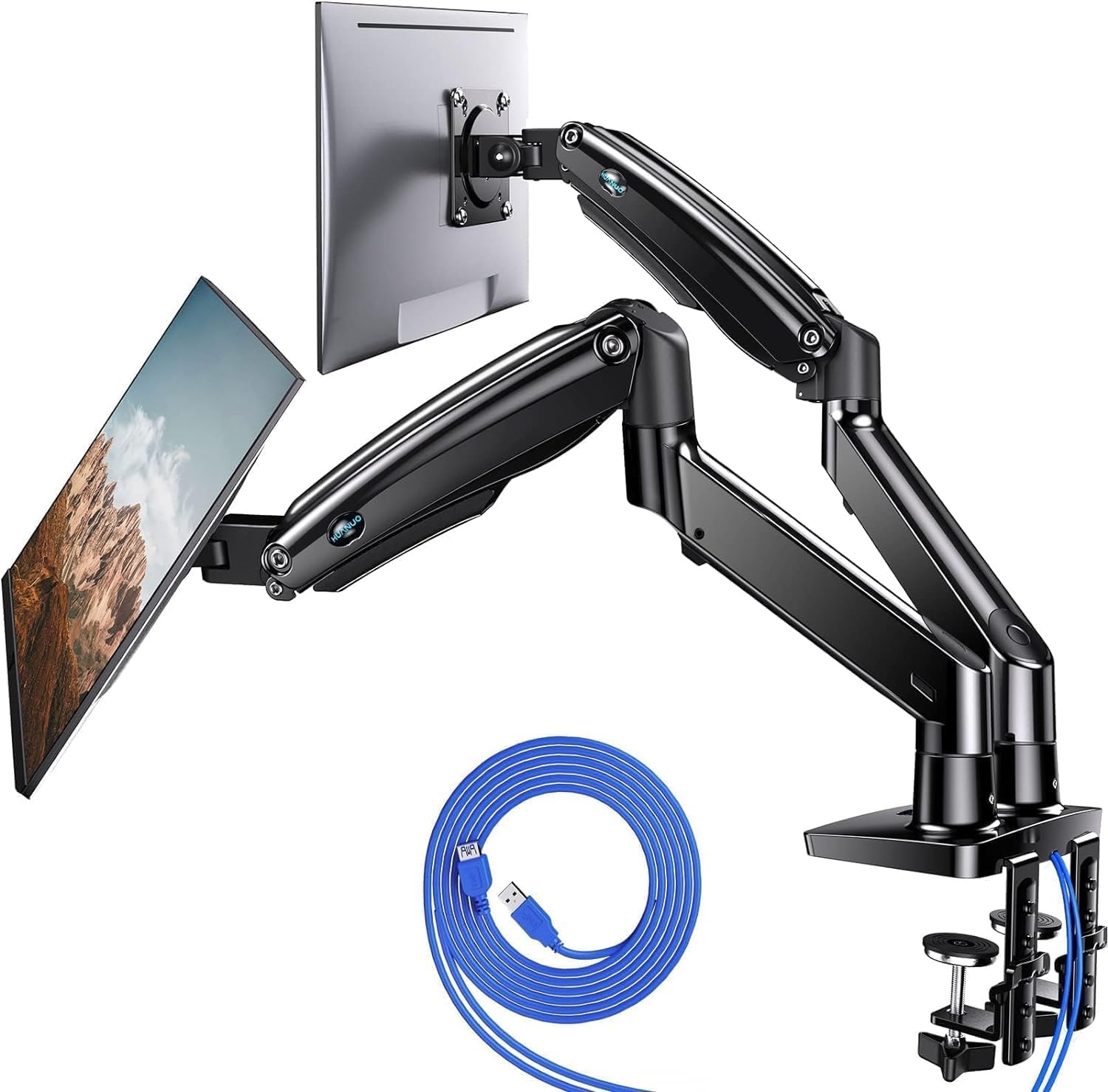
- Supports two 13–40-inch screens weighing up to 26.4 lbs per arm.
- Arms rise to 21.1 inches and extend to 25.59 inches.
- Includes two USB ports and a 5.25 ft USB cable.
Best For: People mounting two larger or heavier monitors who want built-in USB ports.

HUANUO FlowLift Dual Monitor Stand
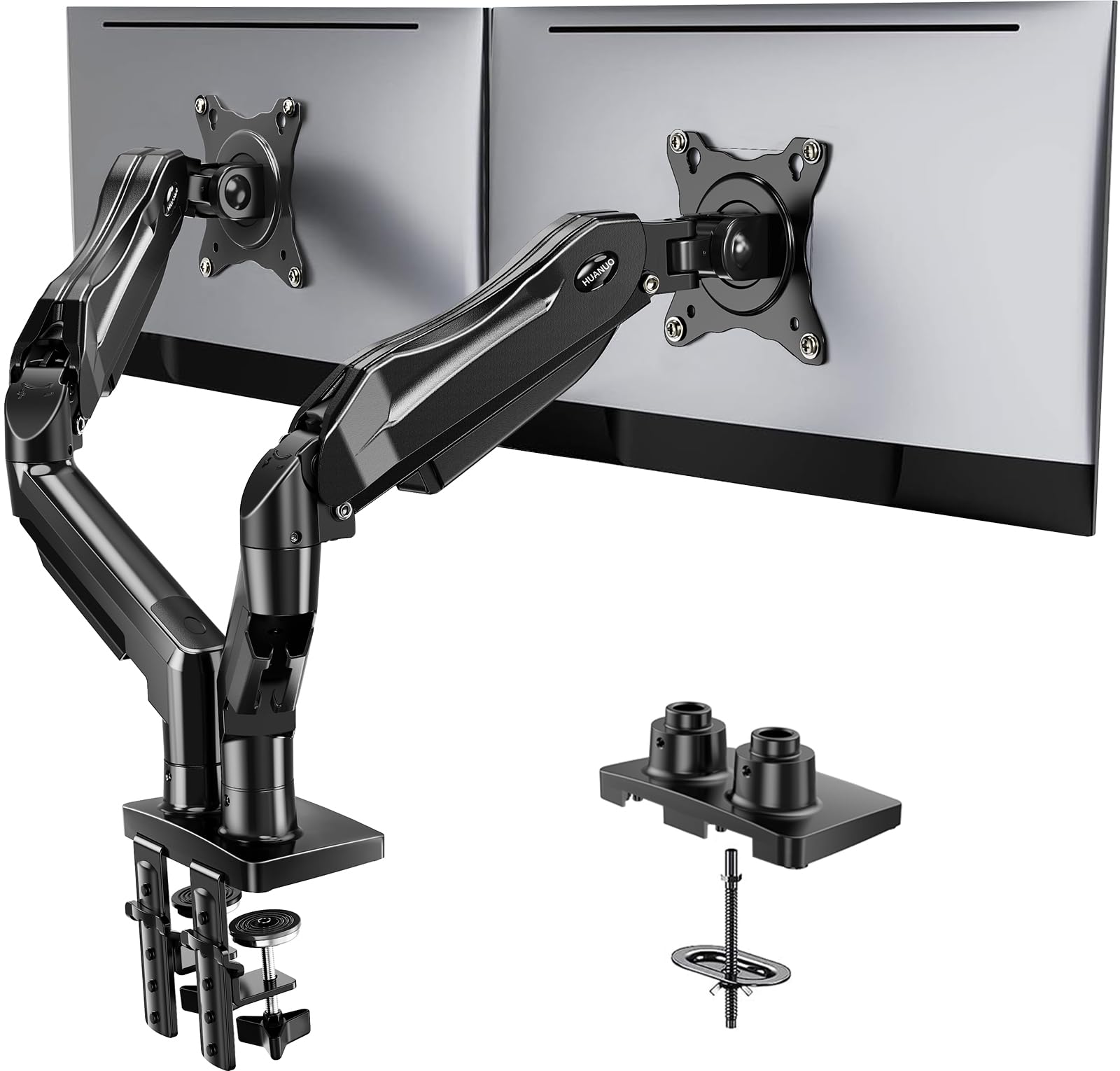
- Supports 13–32-inch monitors weighing 4.4 to 19.8 lbs per arm.
- Provides tilt, swivel, and 360-degree rotation.
- Offers C-clamp or grommet mounting.
Best For: People with compatible wooden desks who want full-motion adjustment and clamp or grommet mounting.
HUANUO Vertical Dual Monitor Stand
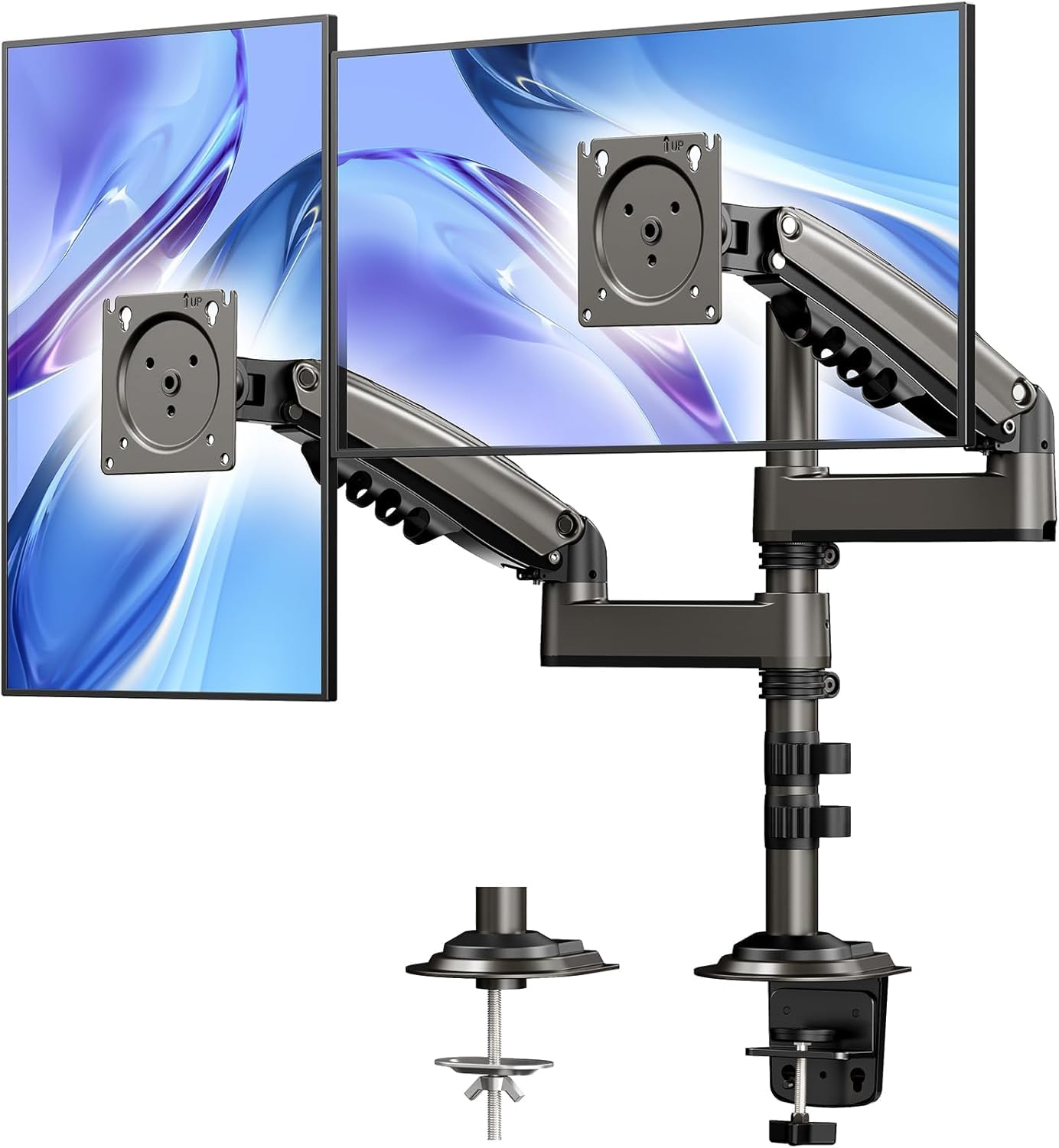
- Arranges two monitors vertically and supports screens up to 32 inches.
- Raises the monitors up to 25.19 inches.
- Supports C-clamp or grommet installation on desks 0.39–3.54 inches thick.
Best For: People who prefer vertically stacked screens and need extra height adjustment.
HUANUO FlowLift Pro Dual Monitor Mount
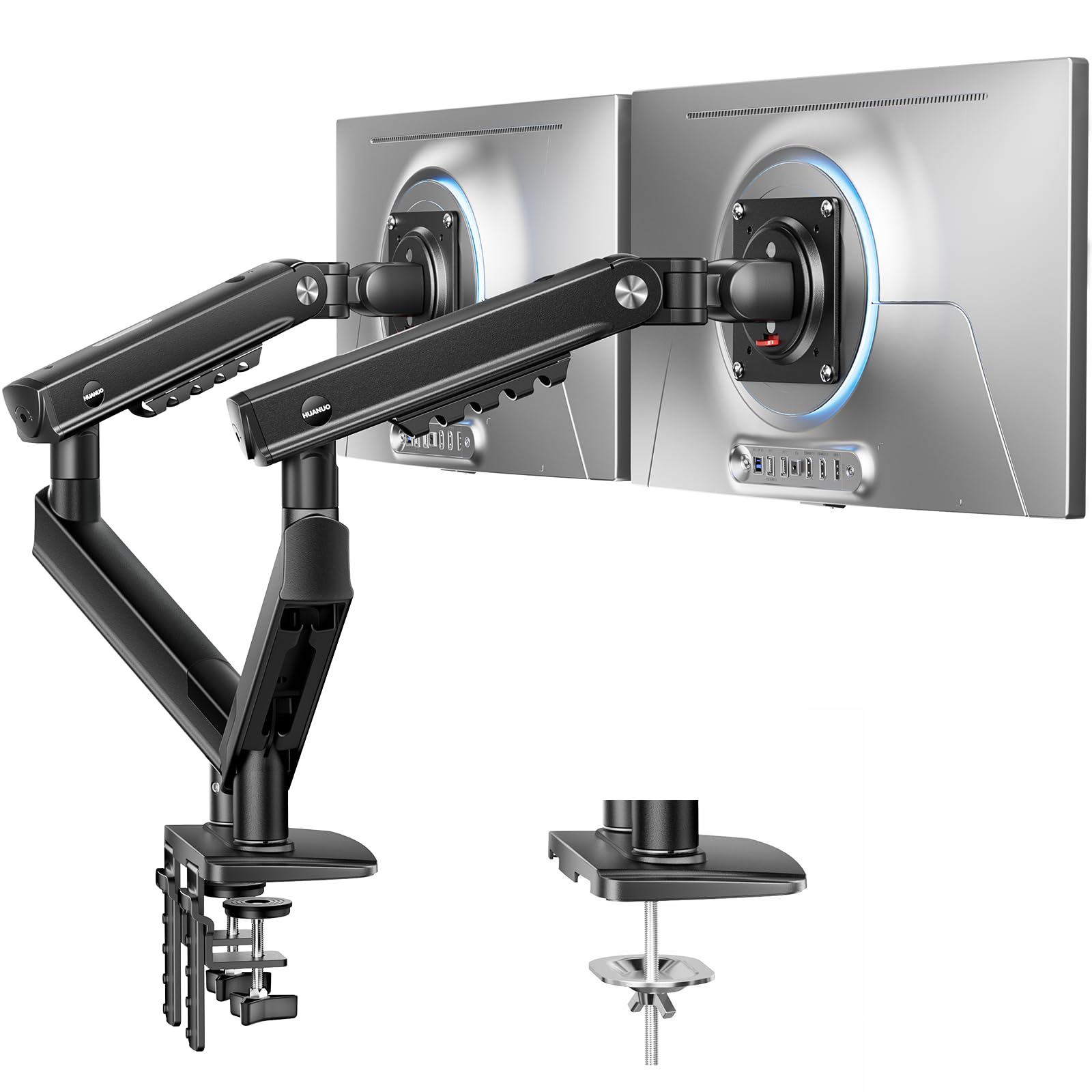
- Fits two 13–27-inch screens weighing 4.4–15.4 lbs each.
- Uses a tool-free InstaMount VESA plate for monitor attachment or removal.
- PrecisionView provides visual feedback during tension adjustment.
Best For: People with lighter 13–27-inch monitors who frequently reposition or detach screens.
HUANUO TitanLift Heavy Duty Monitor Arm
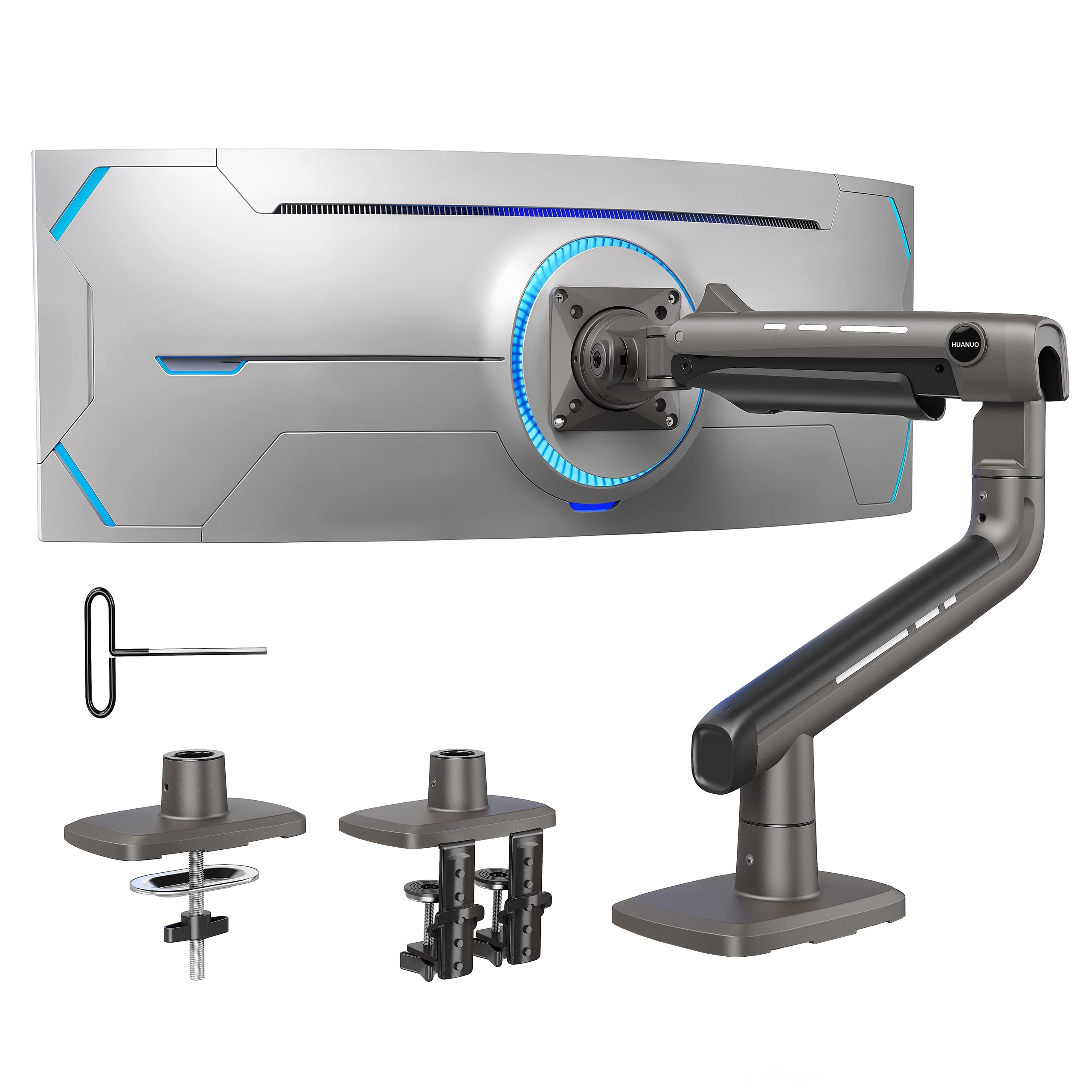
- Supports one monitor from 17 to 49 inches and up to 44 lbs.
- Arm extends up to 22.5 inches and height adjusts up to 19.6 inches.
- Rotates 360 degrees for screens up to 35 inches.
Best For: A user mounting one heavy ultrawide monitor who does not need support for two screens.
For Larger, Heavier Displays
HUANUO Dual Monitor Stand for 13″–40″, Premium Dual Monitor Mount with USB, Height Adjustable Monitor Stand for 2 Monitors, VESA Mount with Clamp/Grommet Base, Holds 26.4lbs per Arm, HNDS7
The HUANUO HNDS7 supports two 13–40-inch screens weighing up to 26.4 lbs per arm, making it the broadest screen-size and load option in this group. Its aluminum arms extend up to 25.59 inches and rise to 21.1 inches, while tilt, swivel, and rotation let you adjust screen position.
A clamp or bolt-through grommet can attach it to desks up to 3.54 inches thick, and the grommet hole needs to be 0.39–1.97 inches in diameter. Two built-in USB ports and a 5.25 ft cable add a charging point, though the larger capacity comes with a higher price than the other listed arms.
Best For: People mounting two larger or heavier monitors who want built-in USB ports.
| Pros | Cons |
|---|---|
|
|
Choose the HNDS7 if your two screens are larger or heavier than the limits of the other dual-arm choices, or if USB ports near the mount are useful. Its wide extension and height range offer positioning flexibility, but check the desk thickness and grommet-hole dimensions before choosing an installation method.
Confirm that each monitor's weight and VESA pattern fit; the product notes give the maximum capacity and screen range but do not state a minimum weight.
Side-by-Side Motion and Two Mounting Options
HUANUO FlowLift™ Dual Monitor Stand, Fully Adjustable Gaming Monitor Desk Mount for 13–32″ Computer Screens, Full Motion VESA 75x75/100x100 with C-Clamp & Grommet Base, Each Arm Holds 4.4 to 19.8 lbs
The HUANUO FlowLift is a side-by-side dual monitor arm for 13–32-inch screens, with each arm rated for 4.4 to 19.8 lbs. It supports VESA 75x75 or 100x100 mounting and offers tilt, swivel, and full 360-degree rotation, including portrait orientation. The screens can rise up to 15.75 inches, and cable management runs along the arms.
Choose between its C-clamp and grommet mounting options, but check the desk carefully: the notes recommend wooden desks between 0.59 and 3.54 inches thick, without cross beams or panels underneath. Plastic and glass desks are unsuitable according to the compatibility guidance.
Best For: People with compatible wooden desks who want full-motion adjustment and clamp or grommet mounting.
| Pros | Cons |
|---|---|
|
|
This FlowLift suits a conventional two-screen workspace where portrait rotation and side-by-side movement matter. Its screen range and per-arm load are narrower than the HNDS7's, so weigh each display and confirm the VESA holes before buying.
The desk requirements are especially important: measure thickness, check the underside for obstructions, and verify that the material is suitable. The choice between clamp and grommet mounting gives some flexibility when the desk meets those conditions.
For a Tall Stacked Setup
HUANUO 17-32 Inch Dual Monitor Stand, Vertical Dual Monitor Mount, Monitor Stand 2 Monitors, Ergonomic Adjustable Tilt/Swivel/Rotate, Weight Max 19.8 lbs, VESA 75/100mm
This HUANUO stand places two 17–32-inch monitors in a vertical arrangement and raises them up to 25.19 inches with an additional 17-inch extension. Each screen needs VESA 75x75 or 100x100 holes and must weigh between 4.4 and 19.8 lbs. The mount tilts 90 degrees, swivels 180 degrees, and rotates 360 degrees for angle changes.
Cable management keeps cords organized along the stand. It attaches with a C-clamp or grommet to solid wood or metal desks between 0.39 and 3.54 inches thick; glass desks are unsuitable.
The tall stacked layout makes desk width less central, but check that the available vertical space fits your screens.
Best For: People who prefer vertically stacked screens and need extra height adjustment.
| Pros | Cons |
|---|---|
|
|
Pick this model when a vertical stack suits your workspace better than placing screens side by side, especially if you need substantial height adjustment. Its 17–32-inch screen range and weight limits rule out some larger or heavier displays.
Check the desk material and thickness, and consider whether the stacked screens will fit the space above the desk. The clamp and grommet options provide installation flexibility, while the cable management helps keep a tall dual-screen arrangement tidy.
Tool-Free Monitor Attachment
HUANUO FlowLift Pro Dual Monitor Mount for 13–27" Screens, MechaSpring Monitor Stand, Adjustable Monitor Arms for 2 Monitors with Tilt/Swivel/Rotation, Tool-Free VESA Mount, Max Load 15.4 lbs
The HUANUO FlowLift Pro is sized for two smaller monitors, supporting 13–27-inch screens that weigh between 4.4 and 15.4 lbs each. VESA 75×75 or 100×100 compatibility is required.
Its tool-free InstaMount VESA plate is designed to make attaching or detaching a monitor easier, while the PrecisionView window shows tension adjustment through an indicator. The notes also describe tilt, swivel, and rotation, but provide no angle ranges.
Desk compatibility is restrictive: wooden desks 0.59–3.54 inches thick are recommended, with caution for irregular edges. If frequent one-handed adjustments matter, the LockSteady system is designed to help resist sagging as screens move.
Best For: People with lighter 13–27-inch monitors who frequently reposition or detach screens.
| Pros | Cons |
|---|---|
|
|
Consider the FlowLift Pro if your displays fit its smaller size and weight limits and you expect to attach or remove monitors or adjust arm tension. The tool-free plate and visible tension indicator address those setup tasks directly.
Its desk guidance is narrower than the vertical HUANUO model, so verify the surface material, thickness, and edge shape. The notes provide no specific tilt, swivel, or rotation angles, so check that the available motion suits your layout before buying.
Single Arm for One Ultrawide
HUANUO TitanLift Heavy Duty Monitor Arm for Screens up to 49", Holds 44 lbs, Aluminum Ultrawide Screen Monitor Mount, Fully Adjustable Single Gaming Desk Mount with Dual C-Clamp, Max VESA 100x100mm
The HUANUO TitanLift supports one 17–49-inch monitor weighing 6.6 to 44 lbs, with VESA 75x75 or 100x100 mounting. Its single arm extends up to 22.5 inches, rises up to 19.6 inches to the VESA mount center, and adjusts through tilt and swivel; it rotates 360 degrees for screens up to 35 inches.
A quick-install VESA head and cable management are included. The clamp is intended for wooden desks 0.8–3.5 inches thick, with no underside cross beams or panels.
This is the only single-monitor arm in the candidate group, so it is a niche fit for someone who wants one ultrawide rather than a true dual-arm setup.
Best For: A user mounting one heavy ultrawide monitor who does not need support for two screens.
| Pros | Cons |
|---|---|
|
|
This TitanLift is a relevant adjacent choice only for someone using one heavy ultrawide and looking at monitor arms generally. It does not meet the core dual-monitor need because it supports a single display.
For a two-screen setup, choose one of the dual-arm products instead; for a single screen, confirm its weight, VESA pattern, and desk clearance. Its 360-degree rotation is supported only for screens up to 35 inches, so larger ultrawides should be positioned with that limit in mind.
How to Choose Dual Monitor Arms
How We Picked Dual Monitor Arms
All five candidates are monitor arms, but one supports a single display rather than a pair. We kept it as an adjacent option for people who may use one ultrawide and treated the four dual-display products as the direct fits.
Their screen size and weight limits, VESA patterns, desk attachment options, motion, and layout distinguish the choices.
The dual-screen options cover side-by-side and stacked arrangements, smaller monitors, and larger displays. Desk compatibility matters just as much: some models recommend wooden surfaces, and desk thickness, underside clearance, or grommet-hole size can affect installation.
The product cards summarize the specific fit factors to check.
Comparing Dual Monitor Arms
The HNDS7 supports the largest screens and highest per-arm load among the dual-display options, and it adds two USB ports. The standard FlowLift covers 13–32-inch screens with full motion and two mounting choices.
For a vertical stack, the B0855ZBPXD offers an extension that raises screens up to 25.19 inches; the FlowLift Pro instead focuses on smaller monitors and adds a tool-free VESA plate and visual tension adjustment.
These differences matter more than a general preference for an adjustable arm. Start with the monitors' actual weights and VESA patterns, then compare the arrangement, movement, and mounting method each model supports.
The single-screen TitanLift is a separate fit for one heavy ultrawide, not for two displays.
| Product | Standout features | Best for |
|---|---|---|
| HUANUO HNDS7 Dual Monitor StandCheck Price |
| People mounting two larger or heavier monitors who want built-in USB ports. |
| HUANUO FlowLift Dual Monitor StandCheck Price |
| People with compatible wooden desks who want full-motion adjustment and clamp or grommet mounting. |
| HUANUO Vertical Dual Monitor StandCheck Price |
| People who prefer vertically stacked screens and need extra height adjustment. |
| HUANUO FlowLift Pro Dual Monitor MountCheck Price |
| People with lighter 13–27-inch monitors who frequently reposition or detach screens. |
| HUANUO TitanLift Heavy Duty Monitor ArmCheck Price |
| A user mounting one heavy ultrawide monitor who does not need support for two screens. |
Desk Fit and Mounting Choices
Before selecting a dual monitor mount, inspect both the desk edge and underside. The standard FlowLift and FlowLift Pro recommend wooden desks and require room beneath the surface; the vertical HUANUO model allows solid wood or metal but excludes glass.
The HNDS7 offers clamp and bolt-through grommet mounting, with a stated diameter range for the hole. Match the desk material, thickness, and clearances to the chosen model.
A clamp avoids making a grommet hole, while a grommet attachment may suit a desk that already has a compatible opening. Both approaches need a stable contact area.
Pay attention to cross beams, panels, irregular edges, and surface material, since they can prevent a mount from fitting as intended.
Matching the Arm to Your Monitors
Check each screen's weight without its original stand and verify its VESA mounting pattern before comparing arms. The dual options here use 75x75 or 100x100 VESA patterns, but their supported weights and screen sizes differ.
The HNDS7 reaches 40 inches and 26.4 lbs per arm; the FlowLift Pro stops at 27 inches and 15.4 lbs. Choose with both limits in view, especially if the displays differ in size or weight.
Consider how you use the displays. Side-by-side full-motion adjustment fits screens that move between shared viewing and focused work, while a stacked arm suits a compact desk arrangement with vertical space available.
A high extension can improve positioning options, but measure the space above the desk and check that both screens can sit where you need them.
Who Should Buy Which Dual Monitor Arm?
Choose the HNDS7 for larger or heavier pairs and built-in USB ports, or the standard FlowLift for a side-by-side setup with portrait rotation and clamp or grommet mounting. The vertical HUANUO arm suits a stacked layout, while FlowLift Pro is aimed at smaller screens and makes attachment and tension adjustment more straightforward.
The TitanLift fits someone who needs one heavy ultrawide monitor rather than two displays. For any choice, compare your monitor weights, VESA holes, desk construction, and available clearance against the arm's specific requirements before ordering.